How To Read Your TSP Statement
Some of you reading the title are thinking, “WHAT?! Who doesn’t know how to read their TSP statement?” Others are thinking, “Finally! I’ve been wanting someone to explain this to me.”
Let’s give it a shot.
I’ll use a few TSP statements to illustrate how things are displayed by this new recordkeeper that leaves a lot to be desired.
On Page One, we have the overall summary:
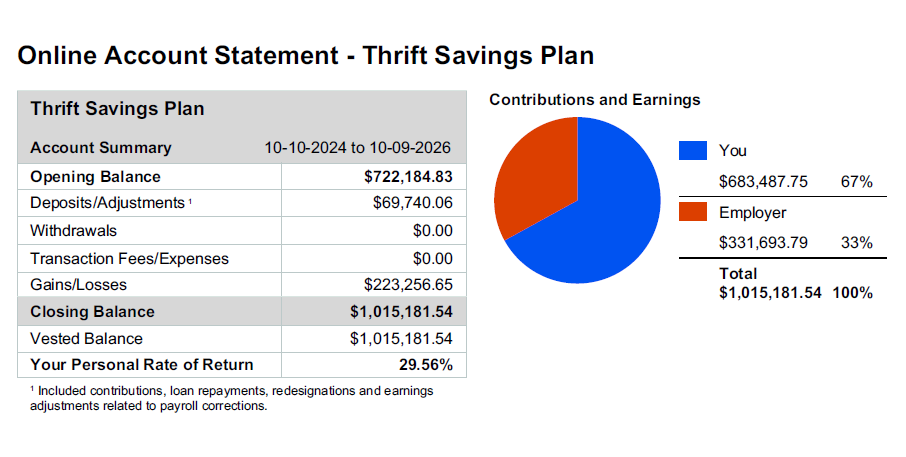
This is really only helpful in illustrating how much:
You’ve contributed+earnings
The government has contributed+earnings
Gains or losses for the period
Your rate of return
What is absent is: Traditional vs Roth balance, the balance in each fund, allocation percentages, etc. Those are coming next.
In this particular example, the Fersonian has just over $1m in their TSP. That is about 2/3 from their contributions and earnings and 1/3 from the government contribution and earnings. You can see that from the pie chart. 67% vs 33%.
You’ll see the term “Vested Balance” under the total. You become vested in the TSP after 3 years in most cases. Meaning after this time, then you get to keep everything the government gave you including the automatic 1%, and the earnings on those contributions even if you leave the government. To be vested in FERS is 5 years, but for TSP it’s generally 3 years.
On the next page we start to see more of a breakdown. And this is where people can get confused.
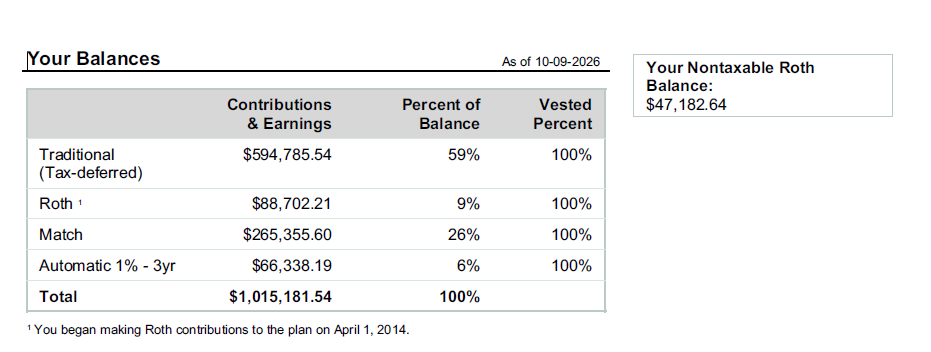
Let’s deal with the left side first:
Traditional (Tax-deferred): $594,785.54. This is the amount the Fersonian has contributed to the Traditional side of his TSP. This is not the balance of his Traditional TSP (more on that in a second), this is simply a record of his contributions and the earnings on those contributions.
Roth: $88,702.21. This is the amount the Fersonian has contributed to his Roth TSP and the earnings that have accumulated on those Roth contributions. So in other words, like the Traditional TSP, this is what he’s done himself. His contributions + his earnings.
The TSP statement doesn’t add these two numbers together on this page but if they did, the resulting total would be what the Fersonian has done for his TSP himself. Aka: his own effort. These would be his contributions + his earnings. Nothing from the government. This was all his doing. $594,785.54 + $88,702.21 = $683,487.75. He was responsible for this amount all by himself. Of the $1m in the TSP, the Fersonian made $683k himself. Go back and look at page one and you’ll see that total.
Match: $265,355.60. Now we are starting to address what the government chipped in. The first two lines were the Fersonian’s contributions and earnings, the next two lines are the government’s contributions and earnings. On this line, we are talking only about the 4% match. The government contributed 4% and that 4% match plus earnings has grown to $265k.
Automatic 1%: $66,338.19. This is the other part of the government contribution. The automatic 1%. We get this whether we contribute to the TSP or not. In this case, the government’s 1% contribution over the years, plus all of the gains attributed to it total $66k.
Total: $1,015,181.54. This is the total of the Fersonian’s TSP balance. It includes his contributions and earnings, plus the government contributions and earnings. But here is where it is a bit confusing—-
There is no total balance of Traditional listed. You’ll see $594k in the Traditional, but that isn’t the total of the Traditional. Why not? Because the lines “Match” and “Automatic 1%” are also inside the Traditional. But for some reason, the TSP never actually shows that balance anywhere??? So what is this Fersonian’s Traditional TSP balance?
$926,479.33 (Traditional + Match + Automatic lines)
Another way to back into this is take the total balance and subtract out the Roth balance and that will leave you the Traditional balance. So $1,015,181.54 Total - $88,702.21 = $926,479.33
Got it?
Less address the weird box in the upper right-hand corner:
“Your Nontaxable Roth Balance”: $47,182.64
Remember that Roth contributions are never taxable but earnings on Roth contributions could be taxable if you withdraw from your Roth TSP prior to 59 1/1 and prior to having the Roth open for 5 years. Because we need to keep track of what might be taxable, we have to keep track of the contributions which are never taxable. In this case, $47k.
The total Roth balance is $88k, but only $47k is nontaxable right now. Once this person is 59 1/2 and has had the account open for 5 years, then all of the Roth balance will be nontaxable. But until then, we have to keep a record of Roth contributions separate from total Roth balance.
And this is why you will see the line that reads “You began making Roth contributions to the plan on April 1, 2014.” This is done to have an accounting of when the 5-year clock started. Which this person long since satisfied.
Next, we have where the money is invested, both current dollars and future dollars:
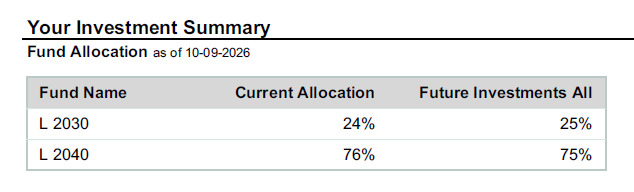
In this particular case, the Fersonian has only two investments and they are both Lifecycle funds: L 2030 and L 2040. (TSP does not recommend this by the way—they want you to put your entire balance into one L Fund if you are using L funds, but alas, an article for another day).
You can see two separate columns that each total 100% on their own. The first one is labeled “Current Allocation”. This is how the money that you have already in your TSP account is allocated, or divided. This person has 24% in L2030 and 76% in L2040. He could just have easily had it in G, S, C, or any number of combinations. Changing this allocation percentage is easily done inside your TSP account. But changing the money that is already inside the TSP does nothing to change future contributions to the TSP. Those two things can be different. That’s the next column.
“Future Investments All” is how the next payroll deduction for TSP is invested. This person has 25% going to L 2030 and 75% going to L 2040. This is very similar to his current balance, but it doesn’t have to be. He could just as easily have 100% G for all future investments, while his past investments are still allocated to L 2030 and L 2040. So changing one does not change the other.
Another example is someone could have 100% C Fund right now, but all future contributions would go 100% G. There is a lot of debate on the efficacy of different strategies for money already in vs money going in but that is beyond the scope of this article.
Summary
I think we can all agree we could come up with a better, clearer way to display our TSP statements, but hopefully this explanation helps.
Remember:
You have to add the lines up to get the total Traditional TSP balance if you also have a Roth
Roth is only fully tax free once you are 59 1/2 and have had it opened for 5 years
Money already in the TSP does not have to be invested the same as future money going into TSP